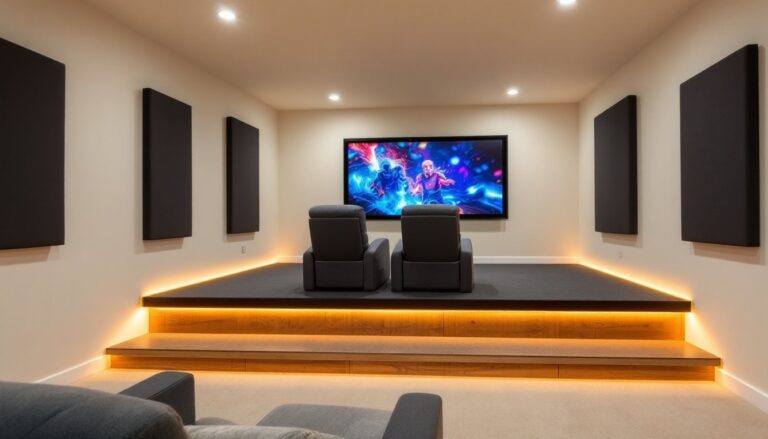
A home theater amplifier isn’t just about volume, it’s the engine that drives the entire audio experience in a dedicated media room. Whether someone’s upgrading from a soundbar or building a full surround system from scratch, the amp determines how cleanly power reaches speakers, how many channels can run simultaneously, and whether dialogue cuts through action sequences without cranking the volume. With streaming services now delivering Dolby Atmos and DTS:X tracks, a capable amp matters more than ever. This guide walks through what to look for, how different amp types stack up, and how to match power and features to room size and budget without overspending or underpowering speakers.
Table of Contents
ToggleKey Takeaways
- A home theater amp is essential for delivering clean power to speakers and achieving the dynamic range and clarity needed for immersive surround sound, especially with modern Dolby Atmos and DTS:X content.
- Match amp power output (measured in watts per channel) to your room size and speaker sensitivity—small to medium rooms need 75–100 WPC, while larger spaces or low-sensitivity speakers benefit from 125 WPC or more.
- AV receivers offer the best balance of features and value for most home theater builds, with mid-range options ($800–$1,500) providing 7–9 channels, HDMI 2.1, and room correction software without overspending.
- Confirm your amp can safely handle your speakers’ impedance (4Ω, 6Ω, or 8Ω) and check continuous RMS power ratings rather than peak specs to ensure realistic performance during actual movie playback.
- Proper installation requires 4–6 inches of ventilation clearance, correct speaker wire gauge (14–16 AWG), secure connections with correct polarity, and room correction calibration for optimal audio quality.
- Plan for future expansion by selecting an amp with preamp outputs and extra channels (7–9 minimum) to allow adding height speakers or external power amplification without replacing the entire system.
What Is a Home Theater Amplifier and Why Do You Need One?
A home theater amplifier takes the low-voltage audio signal from a source, like a streaming device, Blu-ray player, or media server, and boosts it to a level that can drive speakers. Without sufficient amplification, even high-end speakers won’t deliver the dynamic range, clarity, or volume they’re designed for.
Most home theater amps fall into two categories: integrated amplifiers that combine preamp and power amp stages in one unit, or separate components where a preamp/processor handles decoding and a power amplifier handles the heavy lifting. AV receivers are the most common all-in-one solution, bundling tuner, preamp, amplifier, and video switching into a single chassis.
Why bother with a dedicated amp instead of relying on powered speakers or a soundbar? Control and scalability. An amp lets someone match power output to speaker sensitivity and room acoustics, expand to 5.1, 7.1, or even Atmos height channels, and upgrade components individually rather than replacing an entire system. It also handles impedance matching, critical when mixing speakers with different nominal ratings (typically 4Ω, 6Ω, or 8Ω).
For serious home theater builds, an amp ensures dialogue stays intelligible during explosions, bass hits hard without distortion, and surround effects pan smoothly. It’s the difference between hearing a movie and feeling it.
Key Features to Look for in a Home Theater Amp
Power Output and Speaker Compatibility
Power output gets measured in watts per channel (WPC), typically at 8Ω impedance with one or two channels driven. A common spec might read “100 WPC @ 8Ω, 20 Hz–20 kHz, 0.08% THD, 2 channels driven.” Pay attention to that last part, some manufacturers quote power with only one channel active, which isn’t realistic for home theater use.
Matching amp power to speaker sensitivity is crucial. A speaker rated at 90 dB sensitivity (measured at 1 meter with 1 watt input) needs less power to reach the same volume as an 85 dB speaker. For a medium-sized room (around 250–350 square feet), 75–100 WPC usually suffices for speakers in the 87–90 dB range. Larger rooms or lower-sensitivity speakers (below 86 dB) may need 125 WPC or more.
Impedance compatibility matters too. Many amps safely handle 8Ω or 6Ω loads, but only some can drive 4Ω speakers without overheating or triggering protection circuits. Check the manual, if an amp lists “4Ω compatible,” it’ll deliver more power into those speakers (often around 1.5x the 8Ω rating) but may run hotter.
Don’t confuse peak power with continuous (RMS) power. Peak specs look impressive on paper but don’t reflect what the amp can sustain during a two-hour movie.
Channels, Connectivity, and Smart Features
Channel count determines how many speakers an amp can drive simultaneously. A 5.1 system (five main speakers plus a subwoofer) needs five channels. A 7.1.4 Atmos setup (seven ear-level, one sub, four height) requires eleven channels or a combination of amp and external power amplifier.
Most mid-range receivers offer 7 or 9 channels, with preamp outputs for adding external amps if someone wants to expand later. Some feature assignable channels, use them for height speakers, a second zone, or bi-amping front speakers.
Connectivity has evolved. HDMI is the backbone, and in 2026, HDMI 2.1 is the standard for 4K/120Hz gaming, 8K passthrough, and eARC (enhanced Audio Return Channel). Look for at least four HDMI inputs if connecting a game console, streaming box, disc player, and cable box.
Other must-haves:
- Preamp outputs (line-level RCA or XLR) for adding a powered subwoofer or external amp
- Optical/coaxial digital inputs for older sources
- Analog stereo inputs for turntables (via external phono preamp if the amp lacks a built-in phono stage)
- USB and network connectivity for firmware updates and streaming integration
- Room correction software like Audyssey, Dirac Live, or YPAO, which uses a calibration mic to measure speaker output and adjust EQ, delays, and levels
Some amps now include voice control (Alexa, Google Assistant) and app-based setup, which streamlines configuration but isn’t essential for performance.
Types of Home Theater Amplifiers Explained
AV Receivers are the default choice for most home theater builds. They combine amplification, surround decoding (Dolby Atmos, DTS:X), video switching, streaming, and tuner functions in one box. They’re cost-effective and space-efficient, though the all-in-one design limits upgradability. Entry-level models start around $400–$600, mid-tier options run $800–$1,500, and high-end units exceed $2,500. Many of the top home theater amplifiers reviewed in 2026 deliver strong performance in the $1,000–$1,800 range.
Integrated Amplifiers pair preamp and power amp stages without video switching, tuners, or surround decoding. They’re common in two-channel stereo setups but rare in home theater unless someone’s building a minimalist system with an external processor for surround decoding.
Power Amplifiers are standalone units that receive line-level signals from a separate preamp or AV processor. They excel in high-output scenarios, think large rooms or demanding speakers, where a receiver’s onboard amps fall short. Multi-channel power amps range from 2 to 16 channels, with power ratings often exceeding 200 WPC. They generate significant heat and typically require rack mounting or dedicated shelving with ventilation.
Class D Amplifiers use high-frequency switching to achieve efficiency above 85%, running cooler and lighter than traditional Class A/B designs. They’ve shed the “digital amp” stigma of early models: modern Class D amps from Hypex, Purifi, and ICEpower modules deliver clean, powerful output suitable for home theater. They’re ideal for subwoofers and active speaker systems.
Monoblock Amplifiers dedicate one chassis per channel, isolating each speaker’s signal path and power supply. They’re overkill for most home theaters but popular among audiophiles building reference systems. Expect to pay $1,500+ per monoblock.
For DIY installs, AV receivers offer the best balance of features and value. Adding a separate power amp later is straightforward if room size or speaker demands grow.
How to Choose the Right Amp for Your Space and Budget
Start with room size and speaker layout. A small to medium room (up to 300 square feet) with efficient speakers (88 dB sensitivity or higher) can run comfortably on 75–100 WPC. A larger room (400+ square feet) or speakers below 86 dB sensitivity will benefit from 125 WPC or more. For open-concept spaces where sound energy disperses quickly, consider a receiver with preamp outputs and add a two- or three-channel power amp for the front stage.
Speaker impedance affects amp selection. If mixing 4Ω and 8Ω speakers, confirm the amp can handle 4Ω loads on at least some channels. Running a 4Ω speaker on an 8Ω-only amp risks thermal shutdown or damage.
Budget tiers break down roughly like this:
- Under $600: 5.1 or basic 7.1 receivers with HDMI 2.1, room correction, and 75–90 WPC. Good for starter systems or secondary zones.
- $600–$1,200: 7.1 or 9.1 receivers with better power supplies, more robust build quality, and advanced room correction. This range covers most residential installs.
- $1,200–$2,500: High-current designs, 9+ channels, premium DACs, balanced XLR outputs, and refined audio processing. Worth it for dedicated theater rooms or demanding speakers.
- Above $2,500: Separates (processor + power amp), THX certification, and reference-grade components. Overkill unless building a flagship system.
Future-proofing matters. Even if starting with 5.1, buy an amp with 7 or 9 channels if there’s any chance of adding height or surround-back speakers later. Preamp outputs let someone offload power-hungry channels to an external amp without replacing the receiver. Extensive testing by experts often highlights receivers that balance current performance with room to grow.
Don’t chase peak wattage specs. A well-designed 85 WPC receiver with a stout power supply and low-distortion output stage will outperform a poorly implemented 120 WPC unit. Look for third-party measurements from sources like Audioholics or Sound & Vision that publish bench tests showing real-world continuous power output.
Installation Tips for DIY Home Theater Enthusiasts
Placement and ventilation come first. AV receivers generate heat, especially when driving multiple channels at moderate to high volume. Leave at least 4–6 inches of clearance above the unit and 2–3 inches on each side. Avoid enclosed cabinets without ventilation fans. If rack-mounting, consider adding a cooling fan (AC Infinity makes quiet, thermostat-controlled models).
Electrical considerations: A quality home theater amp draws 300–600 watts under load. Plug it directly into a wall outlet or a surge protector rated for at least 1,800 joules and 15 amps. Avoid sharing the circuit with high-draw appliances (space heaters, refrigerators). For dedicated theater rooms, some builders run a separate 20-amp circuit. This isn’t code-required for residential A/V gear, but it provides headroom and reduces the chance of tripped breakers during action scenes.
Speaker wire gauge matters. For runs under 50 feet to 8Ω speakers, 16 AWG is sufficient. Runs over 50 feet or 4Ω speakers benefit from 14 AWG to minimize resistance. Use oxygen-free copper (OFC) wire, it’s not magic, but it’s affordable and resists corrosion better than copper-clad aluminum (CCA). Strip wire ends cleanly, twist strands tight, and secure them in binding posts or banana plugs. Loose connections cause intermittent sound or hum.
Label everything. Use a label maker or masking tape to mark each speaker wire at both the amp and speaker end (e.g., “Front Left,” “Surround Right”). Polarity matters, connect the positive (red) terminal on the amp to the positive terminal on the speaker, same for negative (black). Reversed polarity won’t damage anything but degrades bass and soundstage.
Room correction setup: After physical connections, run the auto-calibration routine. Place the included mic at the primary listening position (typically the center seat, at ear height). Most systems take 3–8 measurements from different spots within the seating area to average out room acoustics. Review the results, sometimes the software misidentifies speaker distances or sets the subwoofer crossover too high. Manual tweaks often improve clarity.
Safety: Wear hearing protection if testing at high volume in an enclosed room. Prolonged exposure above 85 dB can cause hearing damage, and home theater amps can easily exceed 100 dB at full tilt. Turn the volume down before powering on or switching inputs to avoid speaker-damaging pops.
For projects involving in-wall or in-ceiling speaker installation, consult local building codes. Running speaker wire inside walls usually doesn’t require a permit, but some jurisdictions require CL2- or CL3-rated wire (fire-resistant jacket) for in-wall runs. If unsure, ask the local building department.
Finally, firmware updates. Many modern receivers receive bug fixes and feature additions via network updates. Check the manufacturer’s support site every few months or enable auto-update if available. Updated firmware can improve HDMI handshake reliability and add support for new audio codecs. DIY builders looking for deeper technical insights often turn to resources like Popular Mechanics for hands-on guidance and troubleshooting.