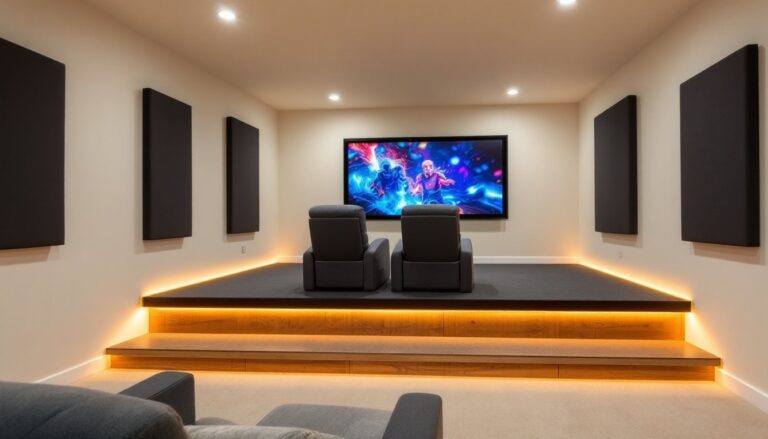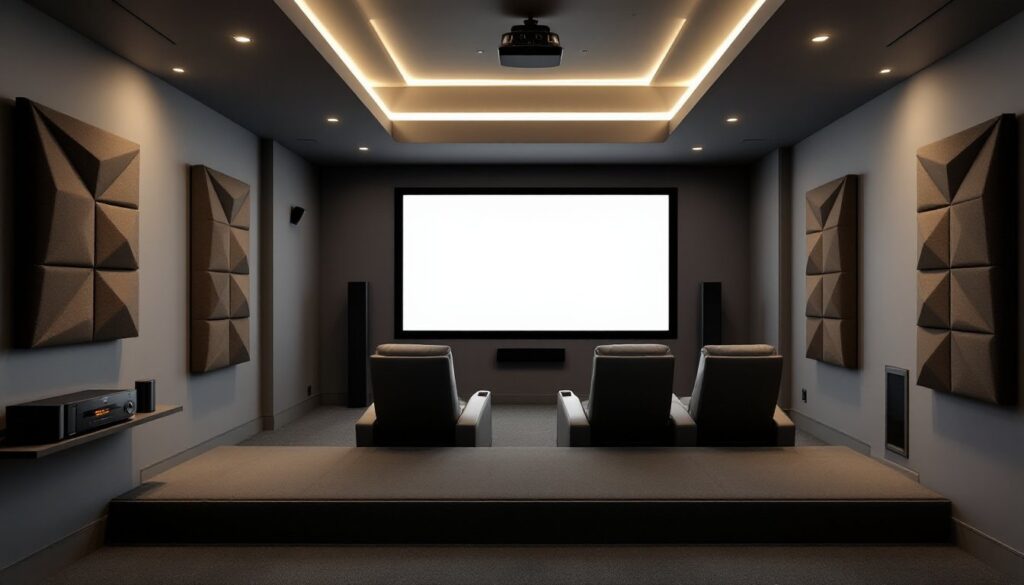

Building a home theater isn’t just about buying the biggest screen and loudest speakers someone can afford. Room dimensions directly affect how sound waves behave, how viewers perceive image quality, and whether the space feels immersive or claustrophobic. Too small, and bass frequencies muddy together: too large, and the sound diffuses before it reaches the seating area. The difference between a disappointing media room and a genuine theater experience often comes down to choosing the right dimensions, and working within the space available. This guide breaks down the measurements, ratios, and practical considerations that separate functional home theaters from acoustic disasters.
Table of Contents
ToggleKey Takeaways
- Home theater room size directly affects acoustic performance and viewing quality, with improper dimensions requiring expensive acoustic treatments that may not fully resolve issues.
- Ideal home theater room size follows proven ratios like Louden’s (1:1.4:1.9) or the Golden Ratio (1:1.618:2.618) to minimize standing waves and modal resonances.
- A minimum viable home theater room size is approximately 11 feet wide × 13 feet long × 8 feet high with proper surround sound, while ceilings below 7.5 feet should be avoided.
- Screen size should be calculated based on viewing distance using SMPTE guidelines: minimum distance of screen width × 1.5 and maximum of screen width × 2.5 for optimal viewing angles.
- Small room home theater setups can succeed by addressing bass issues with corner traps, minimizing reflections with acoustic panels, and using appropriately-sized speakers rather than oversized equipment.
- Common home theater room size mistakes include choosing square layouts, ignoring ceiling height, oversizing screens, and failing to optimize subwoofer placement through positioning tests.
Why Room Size Matters for Your Home Theater Experience
Room dimensions control acoustic performance more than any single piece of equipment. Sound waves reflect off walls, ceilings, and floors, creating standing waves at specific frequencies determined by the distance between parallel surfaces. When a room’s length, width, and height share simple mathematical relationships (like 10×10×8 feet), certain frequencies cancel out while others amplify, creating dead spots and boomy bass.
Proper dimensions minimize these modal resonances. A well-proportioned room distributes sound energy evenly across the frequency spectrum, so dialogue stays intelligible and explosions feel impactful without rattling the drywall. Poor dimensions require expensive acoustic treatments, bass traps, diffusers, absorption panels, that might not fully fix underlying problems.
Room size also dictates viewing angles and screen placement. Sit too close to a large screen, and viewers notice pixels and motion artifacts. Too far, and fine details disappear. The Society of Motion Picture and Television Engineers (SMPTE) recommends a viewing angle between 30° and 40° for immersive theater experiences, which directly correlates to room depth and screen width.
Finally, physical space determines speaker placement options. Surround sound systems require adequate clearance for side and rear channels, plus subwoofer positioning that doesn’t create nulls at the primary seating position. Cramped rooms force compromises that undermine even high-end audio gear.
Ideal Home Theater Room Dimensions and Ratios
The goal is avoiding cube-shaped or perfectly proportional rooms. Instead, aim for dimensions where length, width, and height don’t share simple whole-number ratios. Acousticians have identified several proven ratios that minimize standing waves:
- Louden’s ratio: 1 : 1.4 : 1.9 (height : width : length)
- Dolby’s recommendation: 1 : 1.6 : 2.6
- Golden Cuboid: 1 : 1.618 : 2.618 (based on the golden ratio φ)
For example, a room with 8-foot ceilings would ideally measure approximately 11.2 feet wide × 15.2 feet long using Louden’s ratio, or 12.8 feet wide × 20.8 feet long using Dolby’s guidelines.
Most home theater builders work with existing spaces rather than building from scratch. In those cases, measure the room and calculate the ratios: divide each dimension by the smallest (usually ceiling height). If the results fall reasonably close to the recommended ratios, within 10-15%, the room will perform well acoustically with basic treatments like corner bass traps and first-reflection absorption panels.
The Golden Ratio for Acoustics
The golden ratio (1.618) appears throughout nature and architecture, and it applies to room acoustics because it creates non-integer relationships between dimensions. When room measurements follow this ratio, sound wavelengths interact in complex, non-repeating patterns rather than reinforcing at specific problem frequencies.
A practical golden ratio room might measure 9 feet high × 14.5 feet wide × 23.5 feet long. This configuration spreads modal resonances across the frequency spectrum, preventing the peaks and nulls that plague square or double-cube rooms.
That said, perfect ratios aren’t mandatory. Asymmetrical features, angled walls, coffered ceilings, or built-in shelving, disrupt standing waves just as effectively. Many professional theater designers intentionally introduce irregularities during construction to break up parallel surfaces.
Minimum and Maximum Room Size Recommendations
Minimum viable size for a dedicated home theater with proper surround sound runs about 11 feet wide × 13 feet long × 8 feet high. Anything smaller forces viewers too close to the screen or doesn’t allow adequate clearance for surround speakers. Rooms under 1,100 cubic feet struggle with bass response, low frequencies need volume to develop properly, and small spaces create overwhelming pressure that sounds boomy rather than deep.
For a single row of seating with a 100-inch diagonal screen and 5.1 surround sound, plan for at least 12 feet of depth from screen to seating, plus 2-3 feet behind the seating row for rear channel speakers. Width should accommodate seating plus 18-24 inches clearance on each side for speaker placement.
Maximum practical size depends more on budget than acoustics. Rooms larger than 20 feet wide × 25 feet long × 10 feet high require professional-grade amplification and additional speakers to maintain even coverage. Sound energy dissipates with distance, so large spaces need higher output levels, which means more powerful (and expensive) equipment.
Ceiling height deserves attention. Standard 8-foot ceilings work fine, but 9-10 feet allows for overhead Atmos speakers, riser platforms for second-row seating, and better sound diffusion. Avoid ceilings below 7.5 feet, they create oppressive acoustics and limit speaker placement options.
Very large rooms (over 3,000 cubic feet) often perform better as multipurpose media rooms rather than dedicated theaters. The acoustic compromises required to make them work for movies also make them suitable for gaming, sports viewing, or casual TV watching.
Choosing the Right Screen Size for Your Room
Screen size follows a simple formula based on viewing distance. SMPTE guidelines recommend:
- Minimum viewing distance: Screen width × 1.5
- Maximum viewing distance: Screen width × 2.5
For a 120-inch diagonal 16:9 screen (approximately 105 inches wide), ideal seating falls between 13 feet and 22 feet from the screen. Closer than 13 feet, and viewers perceive individual pixels on 1080p displays: farther than 22 feet, and they lose immersion.
4K resolution changes the math slightly. Higher pixel density allows closer seating, as little as 1× screen width, without visible pixelation. That makes larger screens viable in smaller rooms. A room with only 10 feet of depth could handle a 100-inch 4K display comfortably.
Measure the longest unobstructed sightline in the room, then work backward:
- Determine seating distance (leave 2-3 feet behind seats for walkway/speakers)
- Divide by 2 (for a balanced viewing angle) or by 1.5 (for more immersive experience)
- Result = maximum screen width
- Calculate diagonal using aspect ratio (width ÷ 0.872 for 16:9)
For projection screens, add clearance for the projector mount and throw distance. Short-throw projectors need 4-6 feet: standard throw requires 10-15 feet depending on lens. Measure ceiling height and seating position to ensure the projector’s light path doesn’t create shadows.
Fixed-frame screens require wall mounting, so account for framing depth (typically 2-4 inches). Motorized drop-down screens save space but need ceiling clearance and electrical wiring.
Optimizing Small Spaces for Home Theater Setups
Small rooms (under 150 square feet) present challenges, but they’re fixable with careful planning:
Address bass issues first. Small spaces amplify low frequencies unevenly. Install corner bass traps, fabric-wrapped fiberglass panels (2-4 inches thick) placed in upper and lower corners where walls meet. They absorb energy at problem frequencies without over-deadening the room. Alternatively, use multiple smaller subwoofers placed asymmetrically rather than one large unit: this smooths bass response through destructive interference.
Minimize reflections. In tight quarters, sound bounces off nearby walls before reaching listeners, creating comb filtering (a hollow, phasey quality). Apply 1-2 inch acoustic panels at first-reflection points, the spots on side walls and ceiling where sound from front speakers bounces toward the seating area. Use a mirror at the listening position to locate these points: if you can see a speaker in the mirror, that’s a reflection point.
Downsize speaker types. Bookshelf speakers with 5-6 inch woofers perform better in small rooms than tower speakers. They produce adequate volume without overwhelming the space, and their smaller cabinets fit tighter placements. Pair them with a quality subwoofer to handle bass below 80 Hz.
Manage screen size expectations. A 75-85 inch display or 90-100 inch projection screen often works better than pushing for maximum size. Viewers won’t crane their necks, and the image stays sharp across the entire field of view.
Use the room’s flaws. If the space is long and narrow, run seating along the length with the screen on the short wall. This maximizes viewing distance and provides clearance for surround speakers along the side walls.
Common Room Size Mistakes to Avoid
Choosing a square room. Equal length and width dimensions create identical resonant frequencies in two axes, doubling problematic modes. A 15×15 foot room sounds dramatically worse than 13×17, even though the floor area is similar.
Ignoring ceiling height. Many builders focus on floor dimensions and forget that room volume depends on three axes. An 8-foot ceiling in a 20×15 room creates a different acoustic environment than a 10-foot ceiling in the same footprint, and requires different treatments.
Oversizing the screen. Bigger isn’t always better. A 150-inch screen in a 14-foot-deep room forces viewers into uncomfortably close seats where they’ll notice compression artifacts and experience neck strain during long movies. Calculate based on viewing distance, not available wall space.
Skipping the subwoofer crawl. Bass performance varies wildly depending on subwoofer placement. The “subwoofer crawl” (placing the sub at the listening position, then crawling around the room to find where bass sounds best, then swapping positions) takes 10 minutes and often solves response issues without any acoustic treatment.
Treating room size as fixed. Non-structural walls can often be moved during renovation. If a basement or bonus room is close to ideal dimensions, say, 12×18 instead of the ideal 12×19.2, consider whether bumping out a wall or stealing space from an adjacent closet is feasible. Consult local building codes: most interior wall modifications don’t require permits unless they’re load-bearing, but regulations vary by jurisdiction.
Forgetting HVAC noise. Larger rooms need more climate control, which means longer duct runs and potentially noisier airflow. Plan for in-line duct silencers or baffled vents if the HVAC register is near seating areas. Background noise above NC 30 (Noise Criterion 30) interferes with dialogue intelligibility during quiet scenes.