
Spotting a line of ants marching across the kitchen counter or watching a spider claim your basement corner isn’t just unpleasant, it’s a signal that pests have breached your home’s defenses. Ortho Home Defense has become one of the most widely used insect barrier treatments for homeowners tackling everything from roaches and spiders to ants and earwigs. This liquid insecticide creates a protective perimeter that kills bugs on contact and continues working for months. But effective pest control isn’t just about spraying a product, it requires understanding application zones, timing reapplications correctly, and following safety protocols to protect kids and pets while eliminating unwanted intruders.
Key Takeaways
- Ortho Home Defense creates a long-lasting protective perimeter with bifenthrin, killing pests like ants, roaches, and spiders on contact and continuing to work for months after application.
- Apply a continuous 4-inch indoor band along baseboards, entry points, and behind appliances, and create a 12-inch outdoor barrier up the foundation and out onto the ground for maximum pest prevention.
- Keep pets, children, and aquatic life away from treated areas for 30-60 minutes until surfaces dry completely, and use nitrile gloves and safety glasses when applying the insecticide.
- Reapply Ortho Home Defense indoors every 6-9 months in high-traffic areas and outdoors every 6-8 weeks in humid climates, with signs of returning pests indicating the need for retreatment.
- Combine barrier treatments with exclusion practices like sealing cracks, fixing door sweeps, and clearing vegetation near foundations to prevent pests from bypassing your chemical defenses.
What Is Ortho Home Defense and How Does It Work?
Ortho Home Defense Insect Killer is a ready-to-use liquid insecticide designed for both indoor and outdoor application. The active ingredients, typically bifenthrin (a synthetic pyrethroid), disrupt the nervous systems of insects, causing paralysis and death on contact. The formula dries to form a residual barrier that remains effective long after application.
The product comes in various formulations, including Ortho Home Defense Max Indoor Insect Barrier (for interior use) and Ortho Home Defense Insect Killer for Lawn & Landscape (for outdoor perimeters and lawns). The indoor version uses a battery-powered wand with a comfort wand spray nozzle that allows for continuous application without hand fatigue, crucial when treating an entire home’s baseboards and entry points.
When applied properly, the chemical bonds to surfaces and creates a killing zone. Insects that cross this barrier absorb the insecticide through their exoskeletons. The residual effect means it keeps working between applications, though exposure to rain, UV light, and foot traffic gradually breaks down effectiveness. According to Good Housekeeping product testing standards, residual insecticides should be evaluated for both immediate knockdown and long-term protection.
Target pests include ants, roaches, spiders, centipedes, fleas, ticks, crickets, silverfish, and earwigs. It’s labeled for common household invaders but won’t address infestations that require bait stations (like termites) or fumigation.
Where and How to Apply Home Ortho Defense for Maximum Protection
Effective application requires treating both interior vulnerabilities and the outdoor perimeter where pests originate. Skip either zone and bugs will find the gap.
Indoor Application Best Practices
Start by clearing clutter from baseboards, corners, and under sinks. The spray needs direct contact with surfaces to bond properly, dust, grease, and debris interfere with adhesion.
Key indoor treatment zones:
• Baseboards and floor-wall junctions: Apply a continuous 4-inch band along all baseboards in kitchens, bathrooms, basements, and utility rooms. These are primary travel routes for roaches and ants.
• Entry points: Treat both sides of door thresholds, window sills, and around pipe penetrations under sinks and behind appliances. Insects enter through gaps as small as 1/16 inch.
• Behind and under appliances: Pull out the refrigerator and stove when possible. Treat the floor and wall junction, then push appliances back after the spray dries (typically 30 minutes).
• Closets and storage areas: Don’t skip these. Spiders and silverfish thrive in undisturbed spaces.
Hold the wand at a 45-degree angle about 12 inches from the surface. Move steadily, don’t saturate or leave puddles. One gallon typically covers 1,500 linear feet indoors when applied as a 4-inch barrier.
Pro tip: Apply to cracks and crevices using the wand’s precision setting. For tight gaps behind cabinets, a crack-and-crevice tip (sold separately or use the adjustable nozzle on low volume) prevents over-application.
Outdoor Perimeter Treatment Tips
The outdoor barrier intercepts pests before they reach your foundation. Treat this zone during dry weather, rain within 24 hours of application significantly reduces effectiveness.
Perimeter application steps:
-
Mow and clear vegetation: Trim grass, weeds, and mulch 6-12 inches back from the foundation. Insects use vegetation as bridges over treated zones.
-
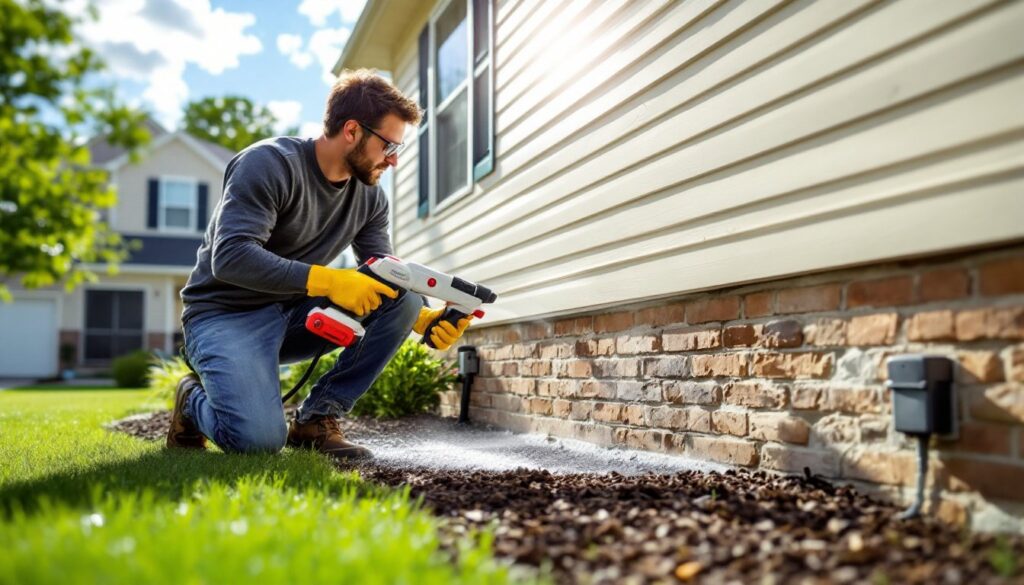
Spray foundation walls: Apply a 12-inch band up the foundation and 12 inches out onto the ground, creating an overlapping barrier. Treat the entire perimeter, garage, porch, and deck foundations included.
-
Treat entry zones: Spray around basement windows, crawl space vents, utility meter boxes, A/C condenser pads, and where utility lines enter the home.
-
Don’t skip the driveway and sidewalk edges: Ants often nest under concrete slabs. Treat expansion joints and cracks.
-
Apply to mulch beds adjacent to the house: Many pests (earwigs, millipedes, spiders) harbor in mulch. Spray the top layer lightly, don’t soak it.
One gallon covers roughly 100-200 linear feet of outdoor perimeter depending on surface porosity (porous brick absorbs more than smooth vinyl siding). For a typical 2,000 sq ft home with a 180-foot perimeter, expect to use about one gallon per application.
Tool alternative: If the battery wand fails or you’re treating a large property, a pump sprayer (1-2 gallon capacity) works well. Mix concentrate versions like Ortho Home Defense Insect Killer for Perimeter & Indoor according to label ratios, typically 0.33-0.5 fl oz per gallon of water for perimeter treatments.
Safety Precautions: Protecting Your Family and Pets During Application
Bifenthrin is a low-toxicity insecticide for humans and pets when dry, but wet product poses risks. Follow these protocols to minimize exposure.
Before application:
• Ventilation: Open windows and run exhaust fans when treating indoors. Even though the “odor-free” labeling, ensuring airflow reduces airborne particles.
• Clear the area: Remove pets, children, and food items from the treatment zone. Cover fish tanks and turn off aquarium pumps, pyrethroids are highly toxic to aquatic life.
• Protect food-contact surfaces: Don’t spray countertops, cutting boards, or inside cabinets where food is stored.
Personal protective equipment (PPE):
• Nitrile or chemical-resistant gloves: Latex breaks down with prolonged pesticide contact.
• Safety glasses: Prevent accidental eye contact, especially when treating overhead areas like window frames.
• Long sleeves and pants: Minimize skin exposure during outdoor application.
• Respirator mask (optional but recommended for sensitive individuals): A NIOSH-approved N95 or P100 respirator reduces inhalation risk during extended indoor application.
During and after application:
• Keep kids and pets out until surfaces are completely dry, typically 30-60 minutes depending on humidity. The product is non-toxic once dry, but wet residue can transfer to skin and paws.
• Don’t spray on windy days outdoors: Drift can contaminate gardens, play areas, or neighboring properties.
• Wash hands thoroughly after handling the sprayer, even with gloves.
• Store the container securely: Keep it in a locked garage or shed, away from children and pets. Don’t transfer to unmarked containers.
Special considerations for homes with pets:
Although dry bifenthrin is low-risk for dogs and cats, birds and reptiles are extremely sensitive. If you own parrots, lizards, or snakes, remove them from the home during indoor application and wait at least 2-4 hours with ventilation before reintroducing them. Fish tanks must be covered and aeration systems turned off.
Pregnancy and chemical sensitivities:
Pregnant or nursing individuals and those with asthma or chemical sensitivities should avoid direct application. Have another household member apply the product, then re-enter once the space is dry and ventilated. Studies on pest control safety, including those cited by Better Homes & Gardens for household chemical use, recommend erring on the side of caution during pregnancy.
How Long Does Ortho Home Defense Last and When to Reapply
Ortho Home Defense claims up to 12 months of protection indoors and 3 months outdoors on non-porous surfaces. Real-world performance depends on environmental factors and pest pressure.
Indoor longevity:
In low-traffic areas like basements and along baseboards, the barrier can remain effective for 9-12 months. High-traffic zones (kitchen floors, entryways) experience faster breakdown from mopping, foot traffic, and cleaning. Expect to reapply every 6 months in these areas.
If you mop baseboards or spot-clean treated areas with detergent, you’re removing the insecticide layer. When possible, vacuum or dry-dust instead. If wet cleaning is necessary, reapply after the surface dries.
Outdoor longevity:
The 3-month outdoor claim assumes moderate weather. Heavy rain, sprinkler overspray, and intense UV exposure degrade the barrier faster. In practice:
• Dry climates (Southwest U.S.): Expect close to 3 months.
• Humid or rainy regions (Southeast, Pacific Northwest): Reapply every 6-8 weeks during spring and summer when pest activity peaks.
• Shaded foundations: Last longer than south-facing walls baking in full sun.
Signs it’s time to reapply:
• Breakthrough activity: If you start seeing ants, spiders, or roaches again after weeks of control, the barrier has degraded.
• After heavy rain or flooding: Any outdoor area that’s been saturated needs retreatment once it dries.
• Seasonal surges: Reapply in early spring (before ants and roaches emerge) and late summer/early fall (when spiders seek indoor shelter).
Calendar-based schedule:
For simplicity, many homeowners treat on a fixed schedule:
• Indoor: March and September
• Outdoor: March, June, and September
This aligns with pest life cycles and ensures the barrier doesn’t lapse during peak activity months. Homes featured in Home Bunch design showcases often integrate pest prevention into seasonal maintenance checklists alongside gutter cleaning and HVAC filter changes.
Product shelf life:
Unopened containers remain effective for 2-3 years if stored in a cool, dry place (ideally 50-80°F). Freezing or excessive heat (above 100°F) can degrade active ingredients. Write the purchase date on the jug so you know when to replace unused product.
Conclusion
Ortho Home Defense provides solid, cost-effective pest control when applied correctly and reapplied on schedule. Success hinges on thorough coverage of indoor and outdoor zones, respecting safety intervals for kids and pets, and recognizing that environmental conditions dictate reapplication frequency more than label claims. Combine barrier treatments with good exclusion practices, seal cracks, fix door sweeps, and eliminate moisture sources, and most homeowners can keep common pests at bay without calling an exterminator.