
Countertop dishwashers have carved out a serious niche in kitchens where space is tight, but the pile of dirty dishes isn’t. Unlike portable or built-in models, these compact units sit right on your counter, plug into a standard outlet, and hook up to your faucet in minutes. They’re not a novelty, they’re a legitimate solution for apartments, tiny homes, RVs, office kitchenettes, or anyone who doesn’t need (or want) a full-size dishwasher. If you’re debating whether a countertop dishwasher makes sense for your setup, this guide covers how they work, what to look for, and how to keep them running efficiently.
Key Takeaways
- A countertop dishwasher is a compact, freestanding appliance that connects to your standard kitchen faucet and outlet in minutes, making it ideal for apartments, rentals, and space-constrained kitchens without installation headaches.
- Countertop dishwashers use only 2–4 gallons of water per cycle compared to hand-washing’s 8–10 gallons, saving significant water and energy while reclaiming 20–30 minutes of daily time for small households.
- Choose a model with at least 6 place settings, dual spray arms, self-cleaning filters, noise ratings below 55 dB, and multiple wash cycles to ensure reliable performance in your kitchen.
- Proper installation requires level counter placement near the sink, a correct faucet adapter fit, and a dedicated 15-amp outlet to avoid electrical overload during heating cycles.
- Regular maintenance—cleaning filters every 7–10 cycles, descaling monthly, and inspecting hoses—extends your countertop dishwasher’s lifespan and keeps it running efficiently.
What Is a Countertop Dishwasher and How Does It Work?
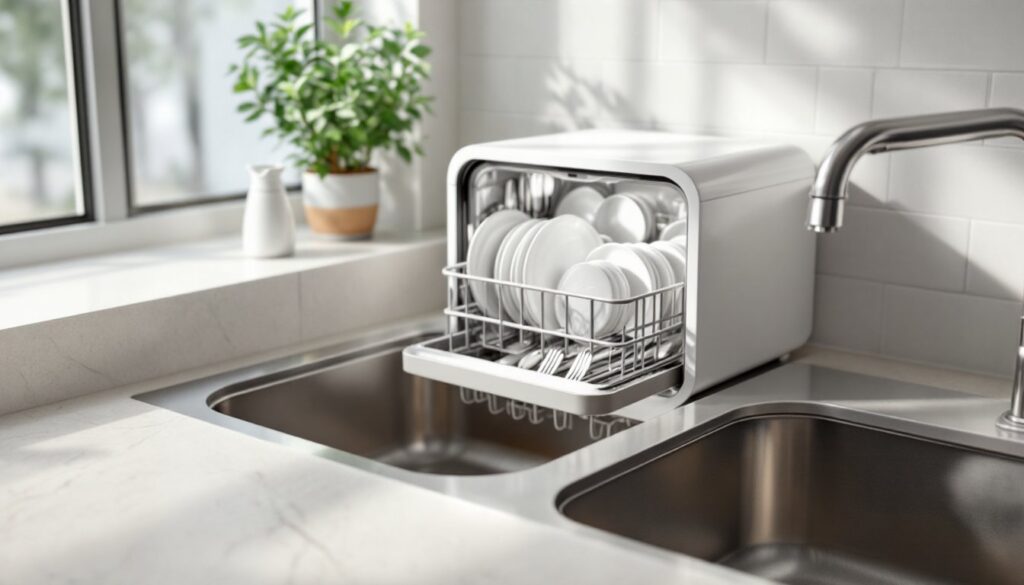
A countertop dishwasher is a compact, freestanding appliance that washes dishes using pressurized spray arms, detergent, and heated water, just like a full-size model, but scaled down. Most units measure roughly 20–22 inches wide, 17–20 inches deep, and 17–18 inches tall, fitting comfortably on standard kitchen counters without blocking sightlines or workspace.
They connect to your kitchen faucet via a quick-connect adapter (usually included) that screws onto the aerator threads. Water flows in, gets heated by an internal element, circulates through spray arms, and drains via a hose into your sink. Most models hold 4–6 place settings, enough for a couple’s dinner dishes or a single person’s daily load. Cycle times run 40–90 minutes depending on soil level and options selected.
Power requirements are straightforward: a standard 120V, 15-amp outlet handles the load. No hardwiring, no plumber, no permit. The trade-off is capacity, you won’t fit a stockpot or a full sheet pan, but everyday plates, bowls, glasses, and utensils wash just fine. These units work best in kitchens where installing a built-in dishwasher isn’t practical due to space, plumbing runs, or rental restrictions.
Top Benefits of Installing a Countertop Dishwasher in Your Kitchen
The biggest advantage is no installation headaches. You don’t need to reroute plumbing, modify cabinets, or hire a contractor. Unbox it, attach the faucet adapter, plug it in, and you’re washing dishes that evening. That makes countertop models ideal for renters who can’t alter the space or homeowners who want a dishwasher in a secondary kitchen, basement kitchenette, or workshop sink area.
Water and energy efficiency is another win. Most countertop dishwashers use 2–4 gallons per cycle, compared to hand-washing a full load which can easily burn through 8–10 gallons. Energy consumption typically ranges 200–300 watts during wash and 800–1,000 watts during the heating/drying phase, translating to roughly 0.6–0.8 kWh per cycle. Over a month, that’s less than running a coffee maker daily.
Space-constrained kitchens benefit from the vertical footprint. Instead of dedicating 24 inches of base cabinet width, you’re using a corner of counter space, often dead zone where small appliances would sit anyway. And because the unit is portable, you can move it aside when prepping large meals or unplug it and store it if you’re hosting and need the counter.
Finally, there’s the time savings. Instead of hand-washing and drying after every meal, you load the dishwasher once a day and let it run. For small households, that’s a solid 20–30 minutes reclaimed daily.
Who Should Consider a Countertop Dishwasher?
Countertop dishwashers shine in specific scenarios. Apartment dwellers top the list, especially those with galley kitchens or older buildings where cabinet space is already tight and adding a built-in dishwasher would require cabinet removal and potentially new plumbing. If your lease prohibits permanent modifications, a countertop unit is a no-brainer.
Singles, couples, or empty nesters who cook at home but don’t generate massive dish piles find the 4–6 place setting capacity perfectly adequate. Running one cycle per day keeps up with normal use without the waste of a half-empty full-size dishwasher. On the other hand, families with young kids or frequent entertainers will outgrow the capacity fast, these units aren’t designed for high-volume use.
Tiny home and RV owners use countertop dishwashers as permanent fixtures. They’re low-draw appliances that don’t overload inverters or shore power, and many small kitchen solutions prioritize multifunctional, compact gear that doesn’t sacrifice function. Similarly, accessory kitchens, think basement wet bars, mother-in-law suites, or garage workshops, benefit from having dish-washing capability without the expense and complexity of a second built-in unit.
If you’re in a temporary living situation (military housing, grad school, short-term rental), the portability is a major plus. You can take the dishwasher with you when you move, unlike a built-in that stays with the property.
Key Features to Look for When Buying a Countertop Dishwasher
Start with capacity and interior layout. A 6-place-setting model gives you more flexibility than a 4-place unit, especially if you cook multi-course meals or use larger dinner plates. Check the tine spacing and rack adjustability, some models have foldable tines or removable cutlery baskets that accommodate taller glasses or wider bowls.
Wash cycle options matter more than you’d think. At minimum, look for normal, heavy, and quick wash modes. An eco or low-temp cycle saves energy when dishes aren’t heavily soiled. A sanitize cycle (reaching 150°F or higher) is useful for baby bottles, cutting boards, or anything that needs extra disinfection. Delay-start timers let you run the dishwasher overnight during off-peak electricity hours if you’re on time-of-use billing.
Noise level is critical since the unit sits on your counter, not hidden behind a cabinet door. Look for models rated 50–55 dB or lower, that’s about the volume of a quiet conversation. Cheaper units can hit 60+ dB, which is noticeably louder and harder to ignore in an open-concept space.
Reviewers at major publications covering dishwasher performance emphasize spray arm design and filtration. Dual spray arms (top and bottom) provide better coverage, while self-cleaning filters reduce maintenance compared to manual-clean mesh screens. Stainless steel interiors resist staining and odor better than plastic tubs, though they add cost.
Drainage flexibility is often overlooked. Some models offer both gravity drain (hose hangs into the sink) and pump-assisted drain, which is useful if your sink sits lower than the dishwasher outlet. And check the power cord length, typically 4–5 feet, to make sure it’ll reach your nearest outlet without an extension cord (which isn’t recommended for high-draw appliances).
Installation and Setup: Getting Your Countertop Dishwasher Running
Installation is straightforward, but a few prep steps prevent headaches. First, measure your counter space. You need a stable, level surface with at least 2–3 inches of clearance on the sides and back for airflow and hose routing. Place the unit near your sink, most inlet hoses run 3–4 feet, so you can’t position it across the room.
Next, remove your faucet aerator and screw on the included adapter. Most adapters fit standard male or female threaded aerators (15/16-inch or 55/64-inch threads), but if you have a pull-down or pull-out faucet with a recessed aerator, you may need a different adapter or a universal kit. Hand-tighten the adapter, then attach the inlet hose, no pipe dope or Teflon tape needed, just snug it down with an adjustable wrench.
Run the drain hose to your sink. If the unit uses gravity drain, loop the hose over the sink edge and secure it with the provided clip or a zip tie. For pump-drain models, make sure the hose has a gentle slope and no kinks. Some users drill a hole in the sink base cabinet and route the drain through to avoid the hose hanging in plain sight, just don’t crimp it.
Plug the dishwasher into a grounded, 15-amp outlet. Avoid sharing the circuit with high-draw appliances like microwaves or electric kettles. If the breaker trips during the heating cycle, you’ve got an overloaded circuit and need to plug into a different outlet or upgrade the circuit (consult an electrician if you’re unsure).
Before the first wash, run an empty cleaning cycle with a cup of white vinegar or a dishwasher cleaner tablet. This flushes out any manufacturing residue or shipping dust. Fill the rinse-aid dispenser if your model has one, it dramatically improves drying performance.
Maintenance Tips to Keep Your Countertop Dishwasher Running Smoothly
Routine care is minimal but non-negotiable. Clean the filter every 7–10 cycles, or sooner if you notice food particles left on dishes. Most models use a removable mesh or screen filter at the tub bottom, twist it out, rinse under hot water, and scrub with a soft brush. Clogged filters kill wash performance and can burn out the drain pump.
Wipe down the door gasket and spray arms monthly. Food particles and mineral deposits accumulate in the spray arm nozzles, reducing water pressure. Remove the arms (usually a quarter-turn or twist-off connection), soak them in warm water and vinegar, then poke out any debris with a toothpick. Check the door gasket for mold or buildup and wipe it with a damp cloth and mild detergent.
Maintaining appliances properly extends their lifespan, advice echoed across homeowner maintenance guides for everything from HVAC to kitchen gear. Descale the unit every 1–3 months depending on your water hardness. Run an empty cycle with a descaling product (citric acid powder or a commercial descaler) to dissolve calcium and lime buildup in the heating element and internal plumbing. If you have very hard water, consider installing an inline water softener or filter on the inlet hose.
Inspect hoses and connections quarterly. Look for cracks, bulges, or leaks at the faucet adapter and drain hose. Replace any worn components before they fail mid-cycle and flood your counter. Keep the exterior clean, stainless steel fronts wipe down with glass cleaner or stainless polish: plastic housings just need a damp cloth.
Finally, don’t overload the racks. Cramming dishes together blocks spray arms and leaves you with half-clean plates. If a dish doesn’t fit comfortably, hand-wash it or wait for the next cycle.
Conclusion
Countertop dishwashers deliver real utility in kitchens where space, plumbing, or budget makes a built-in impractical. They’re not a compromise, they’re purpose-built for small households, secondary kitchens, and anyone who values flexibility over capacity. Focus on capacity, noise, and cycle options when shopping, take five minutes to install it correctly, and keep up with filter cleaning. Done right, a countertop dishwasher will save you hours of scrubbing and gallons of water every week.